

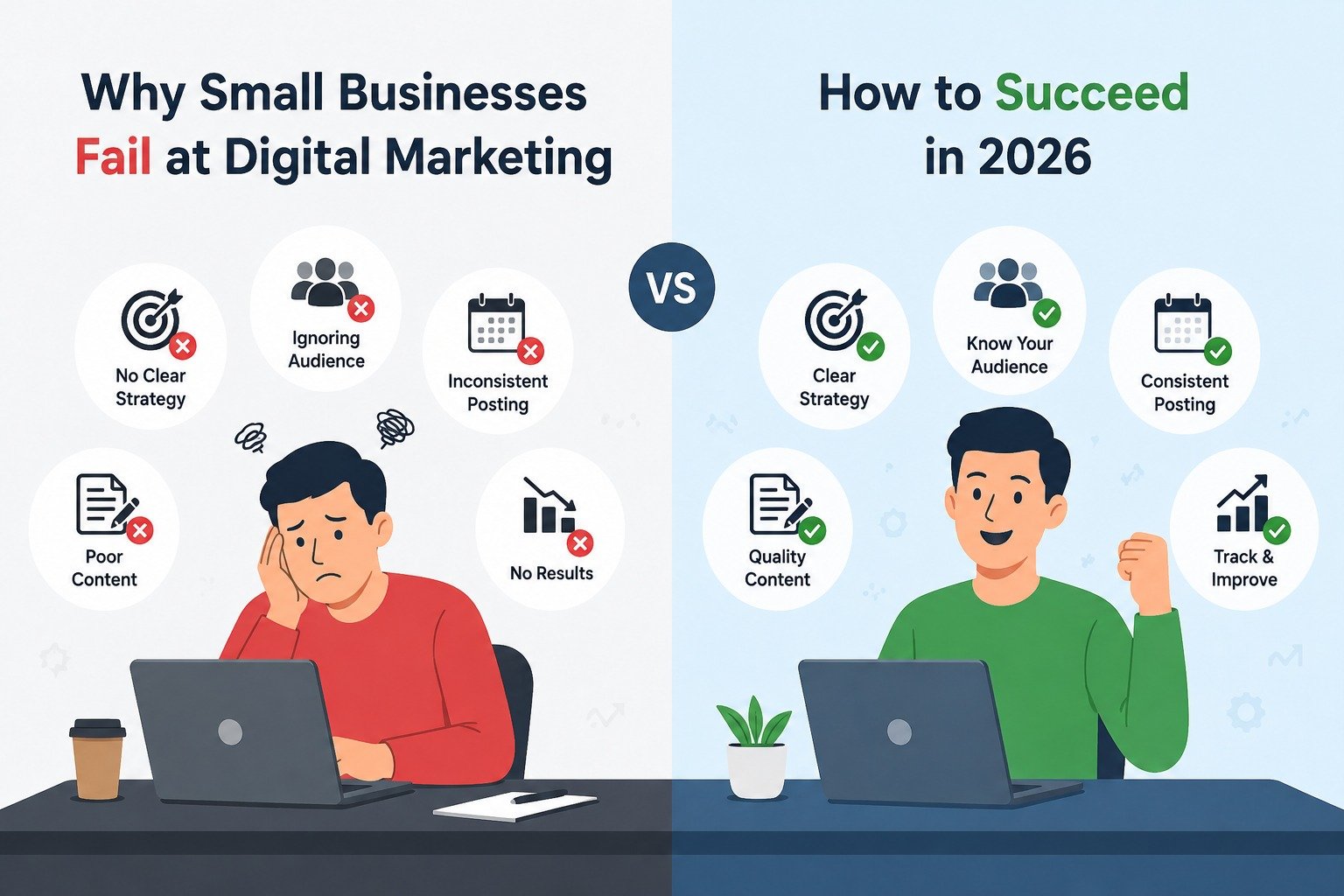
The reality is that digital marketing is one of the most effective ways to grow a business—but only when it's approached with the right strategy. Simply creating a website, posting on social media occasionally, or running a few advertisements isn't enough anymore. Today's customers expect valuable information, trustworthy businesses, and seamless online experiences before making a purchasing decision.
In this article, we'll explore the most common reasons why small businesses fail at digital marketing and, more importantly, the proven strategies that help businesses achieve sustainable online growth.
Why Digital Marketing Is Essential for Small Businesses
Consumer behaviour has changed dramatically over the last decade. Before contacting a business, most people search online, compare multiple companies, read reviews, browse websites, and often ask AI-powered search tools for recommendations.
Whether someone is looking for a nearby restaurant, a dentist, a software company, or a home renovation service, the buying journey almost always begins online.
If your business isn't visible during that journey, you're allowing your competitors to win your customers before you've even had a chance to introduce yourself.
Digital marketing isn't just about attracting visitors—it’s about building trust, demonstrating expertise, and guiding potential customers toward confident purchasing decisions.
1. Focusing on Products Instead of Customer Problems
One of the biggest mistakes small businesses make is talking only about themselves.
Their websites often highlight years of experience, company achievements, and service lists, but they fail to answer the one question every customer has:
"How can this business solve my problem?"
Customers don't search for companies—they search for solutions.
Instead of saying:
"We provide high-quality digital marketing services."
Try explaining the benefit:
"Need more local customers? Our SEO strategies help businesses appear in Google Search when people are actively looking for your services."
When your content addresses customer pain points, it becomes more valuable to both readers and search engines.
2. Having No Long-Term Digital Marketing Strategy
Many small businesses treat digital marketing like a collection of disconnected activities.
One month they focus on Instagram.
The next month they launch Google Ads.
A few weeks later they publish a blog before abandoning content altogether.
Without a clear strategy, every marketing effort works in isolation.
Successful businesses create an integrated digital marketing plan where SEO, content marketing, social media, local SEO, email marketing, and analytics work together to achieve specific business goals.
Consistency—not occasional bursts of activity—is what produces long-term results.
3. Ignoring Search Engine Optimization (SEO)
Some businesses believe paid advertising is enough.
While advertising can generate immediate traffic, those visitors disappear the moment the budget stops.
SEO works differently.
A well-optimized website continues attracting potential customers day after day without paying for every click.
By investing in technical SEO, keyword research, helpful content, and website optimization, businesses create a long-term asset that generates qualified traffic for months and even years.
4. Creating Content Without Understanding Search Intent
Publishing blog posts isn't enough.
The content must answer the exact questions users are searching for.
For example, someone searching:
-
"Best AC repair near me"
-
"AC repair cost"
-
"How long does AC servicing take?"
has three completely different intentions.
Businesses that understand these differences create content that directly satisfies user needs.
This improves rankings, increases engagement, and builds trust.
5. Having a Slow or Outdated Website
Your website creates a first impression within seconds.
If pages load slowly, navigation is confusing, or the site isn't mobile-friendly, visitors are likely to leave before learning about your services.
A successful business website should load quickly, be easy to navigate, display clearly on mobile devices, and make it simple for visitors to contact you.
Good user experience doesn't just improve customer satisfaction—it also supports better search engine rankings.
6. Neglecting Local SEO
For businesses serving specific cities or regions, local visibility is critical.
Yet many businesses never optimize their Google Business Profile, collect customer reviews, or create location-specific content.
When someone searches for services "near me," Google prioritizes businesses with strong local signals.
Optimizing your Google Business Profile, maintaining accurate business information, encouraging genuine customer reviews, and publishing location-focused content can significantly improve local search visibility.
7. Publishing Content That Lacks Value
Search engines have become much better at identifying genuinely helpful content.
Articles written only to include keywords rarely perform well.
Instead, successful businesses publish content that demonstrates real experience, answers common customer questions, shares practical advice, and provides useful insights that readers can't easily find elsewhere.
Quality always outperforms quantity.
One well-researched article can generate more traffic than dozens of short, generic posts.
8. Failing to Measure Marketing Performance
Many business owners continue investing in marketing without understanding what's actually working.
Without tracking website traffic, enquiries, keyword rankings, conversion rates, and customer behaviour, it's impossible to improve performance.
Regularly reviewing Analytics, Search Console, and conversion data allows businesses to make informed decisions instead of relying on assumptions.
Data should always drive digital marketing.
9. Chasing Every New Marketing Trend
Every year introduces new digital marketing trends.
Artificial Intelligence.
Voice Search.
Short-form videos.
AI-powered search.
While innovation is important, constantly switching strategies prevents businesses from building lasting authority.
Instead of chasing every trend, focus on strong fundamentals:
-
Helpful content
-
Excellent user experience
-
Technical SEO
-
Trustworthy information
Once these foundations are in place, new technologies can enhance—not replace—your strategy.
10. Expecting Overnight Results
Digital marketing isn't a quick fix.
Building search visibility, earning customer trust, and improving brand authority all take time.
Businesses that consistently publish valuable content, improve their websites, optimise for search engines, and engage with customers typically see sustainable growth over time.
Patience and consistency remain two of the most important ingredients for digital marketing success.
How Small Businesses Can Build a Successful Digital Marketing Strategy
Instead of trying every marketing tactic available, focus on building a strong foundation.
Start with a fast, mobile-friendly website that clearly explains your services and encourages visitors to take action.
Invest in SEO so your website can attract organic traffic long after content is published.
Create educational blog articles that answer real customer questions instead of constantly promoting your services.
Maintain an active Google Business Profile, encourage customer reviews, and keep your business information accurate across online directories.
Use tools to measure website performance and continuously improve your marketing efforts based on real data.
Most importantly, focus on becoming a trusted source of information within your industry.
Why Strategy Matters More Than Marketing Activities
Many business owners believe digital marketing means posting regularly on social media, running Google Ads, or publishing occasional blog posts.
In reality, these are just marketing activities—not a strategy.
A successful digital marketing strategy aligns your business goals with customer needs, search behaviour, and measurable outcomes. It combines SEO, content marketing, local SEO, website optimisation, analytics, and conversion improvements into a single long-term plan.
From our experience at IQTechway, businesses that invest time in building this foundation typically achieve more sustainable growth than those relying solely on paid advertising or short-term campaigns.
Final Thoughts
Digital marketing success isn't determined by how much you spend—it's determined by how effectively you solve customer problems and build trust over time.
Businesses that understand their audience, invest in SEO, create genuinely helpful content, optimise for local search, and continuously improve their online presence are far more likely to generate sustainable growth.
At IQTechway, we believe digital marketing is more than improving rankings or increasing website traffic. It's about helping businesses connect with the right audience, build lasting credibility, and turn online visibility into measurable business growth.
If your business is looking to strengthen its digital presence, focusing on long-term strategy rather than short-term tactics will always deliver the strongest results.