
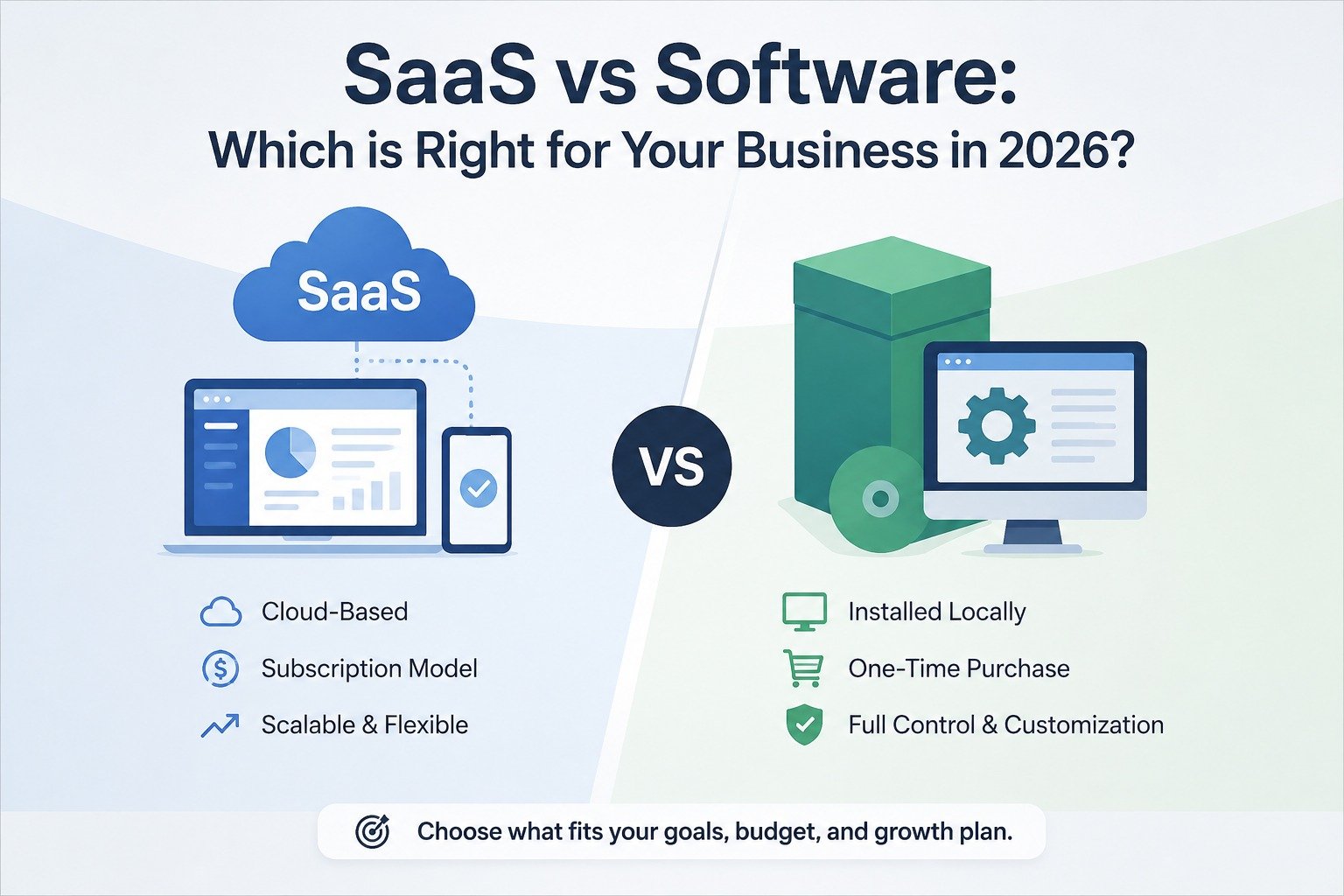
Both have their advantages, but the right choice depends on your business goals, budget, and future growth plans. At IQTechway, we help businesses identify and build software solutions that improve efficiency, scalability, and profitability.
Understanding SaaS Software
SaaS is a cloud-hosted software model that allows businesses to access applications over the internet through a subscription plan, eliminating the need for complex installations and maintenance. Popular examples include CRM systems (https://en.wikipedia.org/wiki/Customer_relationship_management), accounting software, project management tools, and marketing platforms.
Benefits of SaaS
-
Quick implementation with minimal setup
-
Lower upfront investment
-
Automatic updates and maintenance
-
Easy accessibility from any location
-
Suitable for standard business operations
Challenges of SaaS
-
Limited customization options
-
Ongoing subscription costs
-
Dependence on third-party providers
-
Potential limitations as your business grows
For businesses that need a ready-to-use solution quickly, SaaS can be an excellent choice.
What is Custom Software Development?
Custom software (https://www.iqtechway.com/case-study) is designed and developed specifically for your business requirements. Unlike SaaS platforms, every feature, workflow, and integration is built around your organization's unique needs.
Benefits of Custom Software
-
Tailored to your business processes
-
Greater flexibility and scalability
-
Enhanced security and data control
-
Seamless integration with existing systems
-
Competitive advantage through unique features
Challenges of Custom Software
-
Higher initial development cost
-
Longer implementation timeline
-
Requires ongoing maintenance and support
However, businesses with specialized requirements often find that custom software delivers significantly greater value over time.
SaaS vs Software: Key Differences in 2026
Cost
SaaS solutions generally require lower upfront costs but involve recurring monthly or annual subscriptions. Software requires a larger initial investment but eliminates ongoing licensing fees.
Customization
SaaS platforms offer predefined features, while software allows complete control over functionality, user experience, and integrations.
Scalability
As businesses grow, SaaS platforms may require expensive upgrades or additional subscriptions. Software can be designed to scale according to your business needs.
Security
Data security is a major concern in 2026. Custom software (https://en.wikipedia.org/wiki/Custom_software) offers greater control over security measures, compliance requirements, and sensitive business data.
Ownership
With SaaS, you're essentially renting the software. With custom software, your business owns the product and controls future development.
Which Solution Should Your Business Choose?
Choose SaaS If:
-
You need software immediately.
-
Your business processes are relatively standard.
-
You have a limited budget.
-
You prefer minimal maintenance responsibilities.
Choose Custom Software If:
-
Your workflows are unique.
-
You require advanced integrations.
-
Security and compliance are priorities.
-
You want a long-term technology investment.
-
You need a solution that grows with your business.
Why Businesses Trust IQTechway
At IQTechway, we specialize in Software Development (https://www.iqtechway.com/software-development), Web Application Development, Mobile App Development, and Enterprise Software Solutions. Our team works closely with clients to understand their challenges and build scalable software that delivers measurable business results.
Whether you need a custom CRM, ERP system, customer portal, or business automation platform, IQTechway develops solutions that align perfectly with your goals and future growth plans.
Final Thoughts
In 2026, there is no one-size-fits-all answer to the SaaS vs Software debate. SaaS offers speed and affordability, while software provides flexibility, ownership, and long-term scalability.
The best choice depends on your business requirements, budget, and vision for growth. If you're evaluating software options, IQTechway can help you make the right decision and build a solution (https://www.iqtechway.com/contact-us) that supports your success for years to come.
Frequently Asked Questions (FAQs)
1. What is the biggest advantage of SaaS software?
The biggest advantage is quick deployment with low upfront costs, making it ideal for businesses that need immediate solutions.
2. Why choose custom software development?
Custom software is built specifically for your business, providing better flexibility, scalability, and long-term value.
3. Is custom software secure?
Yes. Custom software allows businesses to implement tailored security measures and maintain greater control over sensitive data.
4. Can custom software work with the tools my business already uses?
Yes. Custom software can be designed to connect smoothly with the systems you already rely on, such as CRM platforms, ERP software, accounting tools, payment gateways, and other third-party applications. This helps improve workflow efficiency, reduces manual work, and ensures all your business data stays connected in one ecosystem..
5. Which is more cost-effective in the long run: SaaS or Software?
While SaaS has lower initial costs, software often becomes more cost-effective over time because there are no recurring licensing fees.
6. How can IQTechway help with software development?
IQTechway provides end-to-end software development services, including consultation, design, development, testing, deployment, and ongoing support for businesses across industries.