

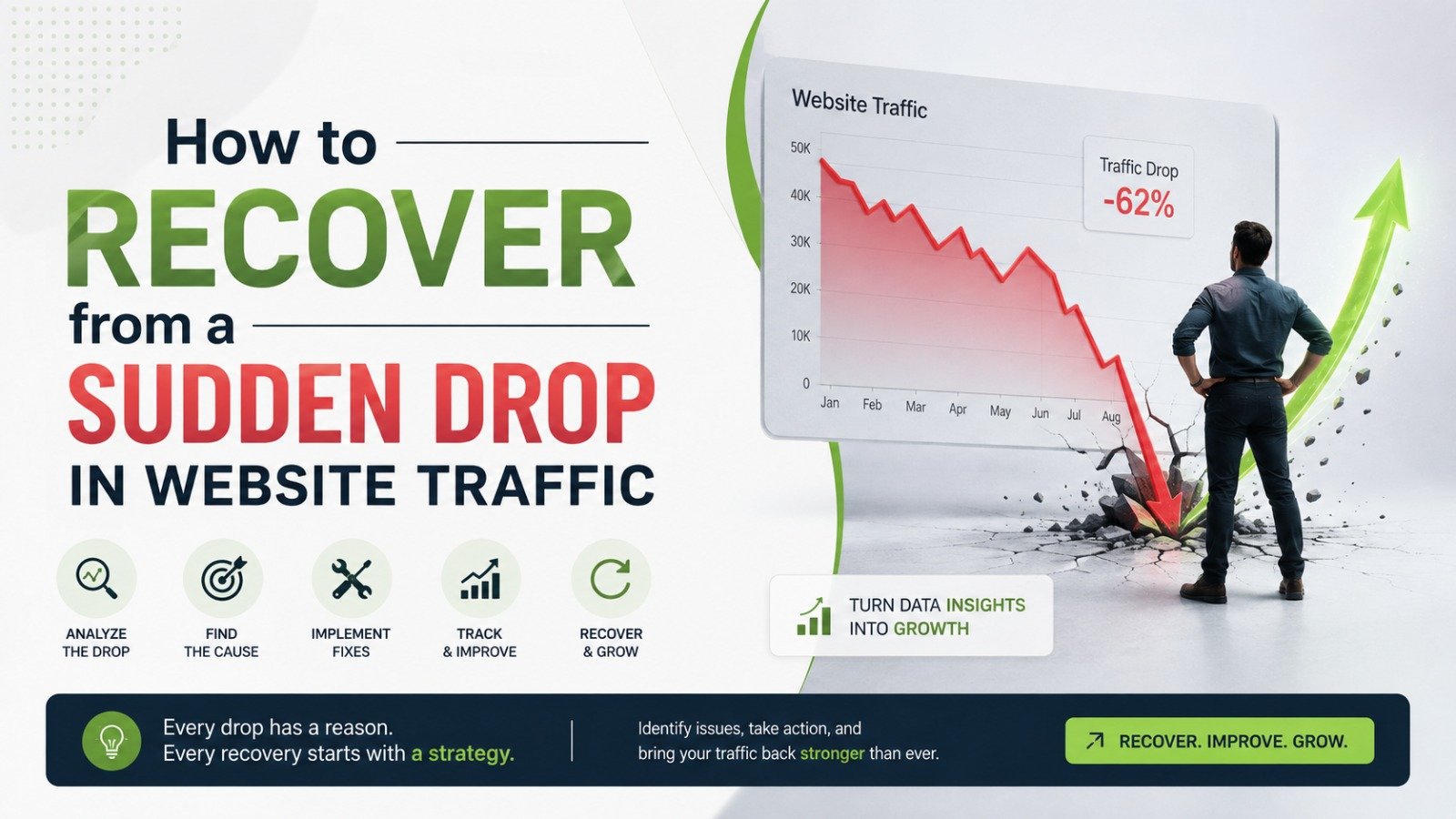
Traffic can fall because of technical SEO issues, indexing problems, algorithm updates, content changes, increased competition, seasonal demand, or even analytics tracking problems.
The first step is not to make immediate changes. It is to understand when the traffic dropped, which pages were affected, and what changed around that time.
At IQTechway, our approach to traffic declines focuses on identifying the underlying issue through data, technical analysis, content evaluation, and search-intent analysis.
Why Does Website Traffic Suddenly Drop?
Some of the most common reasons include:
-
Google ranking fluctuations or ranking-system updates
-
Pages becoming deindexed
-
Website redesign or migration
-
Broken redirects or canonical issues
-
Declining content relevance
-
Changes in search intent
-
Increased competition
-
Seasonal changes in search demand
-
Website security issues
-
Analytics or tracking problems
Because there can be multiple causes, the same recovery strategy will not work for every website.
1. Check Google Search Console First
Google Search Console is one of the most useful places to begin.
Compare the period before and after the traffic decline and check:
-
Clicks
-
Impressions
-
Average position
-
CTR
-
Search queries
-
Top-performing pages
If impressions and rankings have declined, the website may have lost search visibility.
If impressions remain stable but clicks have fallen, investigate CTR and how your pages appear in search results.
Also check the Indexing and URL Inspection reports to make sure important pages are still indexed.
2. Find Which Pages Lost Traffic
Don't focus only on the overall traffic percentage.
Identify the specific pages responsible for the decline.
For example, if your service pages are stable but several blog posts have lost traffic, the problem may be related to content relevance or changing search intent.
Compare:
Before the decline
-
Which pages received the most traffic?
-
Which keywords generated clicks?
-
What were their average positions?
After the decline
-
Which pages lost visibility?
-
Which keywords declined?
-
Did competitors replace your rankings?
This page-level analysis can provide much more useful information than looking at total traffic alone.
3. Check for Technical SEO Problems
Technical issues can sometimes cause important pages to lose visibility.
Check:
-
Robots.txt
-
noindex directives
-
Canonical tags
-
XML sitemap
-
Redirects
-
404 errors
-
Server errors
-
Mobile usability
-
Core Web Vitals
-
HTTPS
-
Page loading performance
Also review whether the website was recently redesigned, migrated, or modified.
A small technical change can sometimes affect many URLs at once.
4. Re-Evaluate Your Content
If technical issues are not responsible, review the content that lost rankings.
Ask:
-
Does the content still satisfy the user's search intent?
-
Is the information accurate and up to date?
-
Does it provide useful, original information?
-
Are competing pages providing better answers?
-
Does the page demonstrate real expertise or experience?
Don't simply add more words.
A useful 1,000-word article can be more valuable than a 3,000-word article that does not answer the user's actual question.
Focus on improving relevance, usefulness, accuracy, and clarity.
5. Strengthen EEAT
EEAT stands for:
Experience, Expertise, Authoritativeness, and Trust.
For business websites, these signals can be demonstrated through:
-
Experienced authors
-
Original examples
-
Case studies
-
First-hand insights
-
Accurate information
-
Relevant references
-
Clear company information
-
Transparent contact details
For example, instead of simply saying "SEO audits can improve website performance," explain how your team actually investigates a website and what evidence you use to identify problems.
That demonstrates practical experience rather than making a generic claim.
6. Check for Algorithm Updates and Competition
If the traffic decline happened around a Google ranking-system update, investigate whether your affected pages changed in visibility.
However, don't immediately assume that Google has penalized your website.
Compare your website with current competitors.
Look at:
-
Content quality
-
Search intent
-
Page structure
-
Topical coverage
-
Internal linking
-
User experience
-
Demonstrated expertise
Your objective should be to understand why competing pages are now more useful or relevant, rather than trying to find a shortcut to regain rankings.
7. Don't Make Too Many Changes at Once
One of the biggest mistakes after a traffic decline is changing everything immediately.
Avoid:
-
Rewriting every page
-
Changing all URLs
-
Buying large numbers of backlinks
-
Deleting content without analysis
-
Changing the website structure unnecessarily
Instead:
Diagnose → Prioritize → Fix → Monitor → Improve
Make controlled changes and track the results.
This makes it easier to understand what actually improved the website.
How Long Does Recovery Take?
There is no guaranteed recovery timeframe.
A tracking problem may be corrected quickly, while content-related ranking losses or increased competition may require longer-term improvements.
The recovery period depends on the underlying cause, the scale of the issue, and how search engines process the changes made.
A reliable SEO process should focus on evidence and measurable improvements rather than promising instant ranking recovery.
Final Thoughts
A sudden traffic decline is a reason to investigate—not panic.
Start with Google Search Console and analytics, identify the affected pages and keywords, check technical SEO, review search intent, and evaluate your content against the current search results.
Most importantly, don't treat every traffic drop as a Google penalty.
Find what changed, understand why it changed, and then make informed improvements.c
At IQTechway, we use this data-driven approach to help businesses identify SEO issues and build sustainable organic search visibility.
If your website has experienced a sudden traffic decline, a structured SEO audit can help determine whether the cause is technical, content-related, competitive, or related to search visibility.