
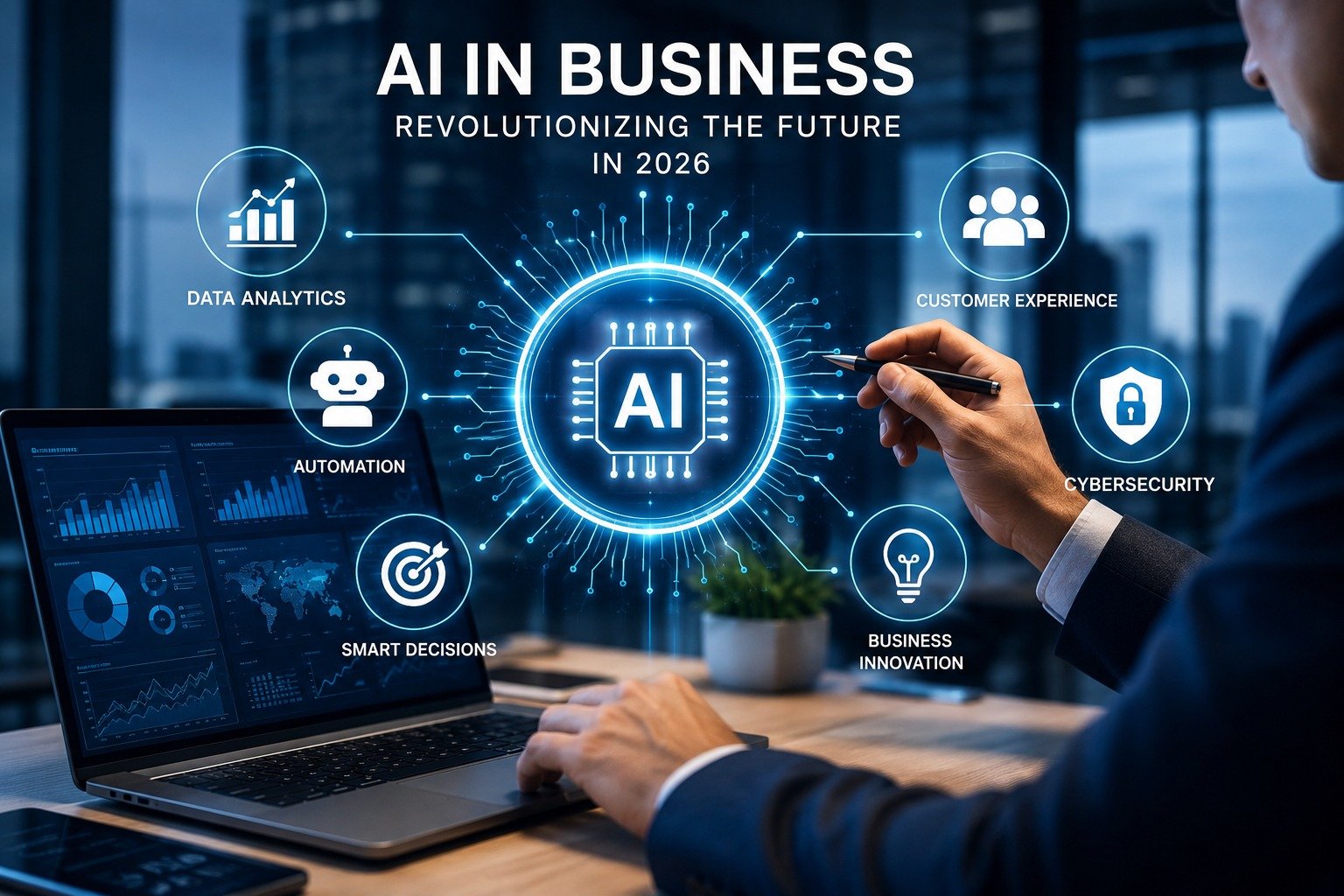
From automating operations to delivering hyper-personalized customer experiences, AI is transforming how companies operate, compete, and grow in every industry.
1. Smarter Decision-Making with Real-Time Data
Today’s businesses continuously generate enormous amounts of data. AI systems can analyze this data instantly and provide actionable insights that were once impossible to detect.
In 2026, companies rely on AI-powered analytics tools to:
Predict market trends
Understand customer behavior
Identify risks before they occur
Improve financial forecasting
This shift has made decision-making faster, more accurate, and data-driven rather than intuition-based.
2. Hyper-Personalized Customer Experiences
AI has completely changed how businesses interact with customers. Instead of generic marketing, companies now deliver highly personalized experiences across websites, apps, and social media.
AI enables:
Personalized product recommendations
Smart chatbots with human-like responses
Dynamic pricing based on user behavior
Targeted advertising campaigns
This level of personalization significantly increases customer satisfaction and conversion rates.
3. Automation of Business Operations
One of the biggest revolutions AI has brought is automation. Repetitive and time-consuming tasks are now handled efficiently by intelligent systems.
Key areas of automation include:
Data entry and processing
Email and customer support responses
Inventory and supply chain management
HR recruitment screening
This allows employees to focus more on strategy, creativity, and innovation.
4. AI in Marketing and Digital Growth
Marketing in 2026 is heavily AI-driven. Businesses are using AI tools to optimize campaigns in real time and maximize ROI.
AI helps in:
Predicting campaign performance
Social media content generation
Customer segmentation and targeting
This results in more efficient marketing budgets and higher engagement rates.
5. Enhanced Cybersecurity and Risk Management
As digital threats become more advanced, AI plays a crucial role in protecting business systems. AI-powered security tools can detect unusual patterns and prevent cyberattacks before they happen.
Businesses now use AI for:
Fraud detection in transactions
Network security monitoring
Threat prediction and response
Identity verification systems
This has significantly improved trust and safety in digital ecosystems.
6. AI-Powered Product and Service Innovation
AI is not just improving existing systems—it is also helping create entirely new products and services. Businesses are using AI to innovate faster than ever before.
Examples include:
Smart applications with predictive features
AI-driven SaaS platforms
Voice and image-based search systems
Intelligent virtual assistants
Innovation cycles have become shorter, allowing companies to launch and scale faster.
7. The Rise of AI-Driven Business Models
In 2026, many companies will be built entirely around AI-first models. These businesses use AI as the foundation of their operations rather than just a supporting tool.
This includes:
Fully automated e-commerce stores
AI consulting platforms
Predictive service-based industries
Intelligent SaaS ecosystems
AI has evolved into a core business strategy rather than just a technological enhancement.
Conclusion
AI is fundamentally reshaping modern business applications in 2026. From automation and analytics to marketing and cybersecurity, it is driving efficiency, innovation, and growth across all sectors.
Businesses that embrace AI today are not just improving performance—they are building the future of competitive advantage. At IQTechway, we help businesses harness the power of Artificial Intelligence, automation, and digital innovation to streamline operations, enhance customer experiences, and achieve measurable business outcomes in an increasingly competitive marketplace.