

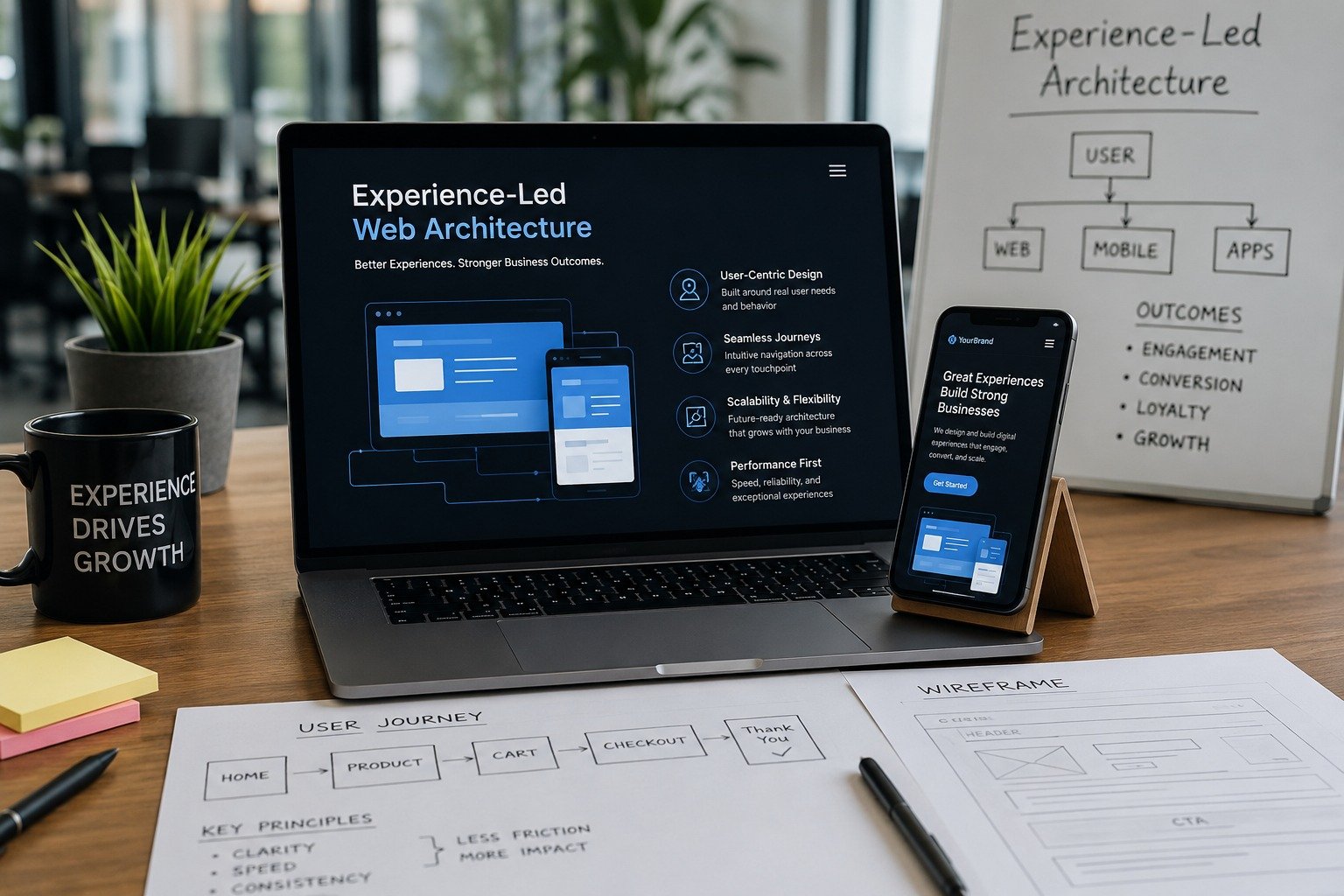
This shift is changing how businesses approach web development. Companies are moving beyond traditional website design and adopting experience-led web architecture, a strategy focused on performance, usability, scalability, SEO, and customer behavior.
In a highly competitive digital environment, businesses need websites that not only look good but also create meaningful user experiences that support growth.
What Is Experience-Led Web Architecture?
Experience-led web architecture is a modern approach to website development that prioritizes how users interact with a digital platform.
Instead of focusing only on visuals, this strategy combines:
User experience (UX)
Website performance
Mobile responsiveness
SEO structure
Accessibility
Conversion optimization
Content strategy
Scalable development
The goal is to create websites that are:
Fast
Intuitive
User-focused
Search-engine friendly
Business-driven
Modern users expect seamless digital interactions. Businesses that fail to deliver smooth experiences often lose potential customers before meaningful engagement even begins.
Why Traditional Websites Are No Longer Enough
For years, many businesses treated websites as simple online brochures. A visually attractive homepage was often considered sufficient.
That approach no longer works.
Today’s consumers expect:
Fast-loading pages
Easy navigation
Mobile-friendly interfaces
Personalized experiences
Clear information structure
Smooth interactions across devices
At the same time, search engines now prioritize websites that deliver better user experiences. Factors such as page speed, mobile usability, structured content, and engagement signals directly influence visibility in search results.
Modern websites must function as complete digital ecosystems that support branding, marketing, customer engagement, and business growth.
User Experience Has Become a Business Strategy
The quality of a user’s digital experience now plays a critical role in shaping how people view a business.
A well-structured website helps users:
Find information faster
Navigate effortlessly
Build trust quickly
Complete actions smoothly
Whether users are making a purchase, submitting an inquiry, or exploring services, frictionless experiences increase the likelihood of conversion.
Businesses investing in experience-led architecture often see improvements in:
Customer engagement
Conversion rates
Session duration
Brand credibility
Lead quality
Modern consumers value convenience. Businesses that simplify digital interactions gain a significant competitive advantage.
Website Performance Directly Influences Growth
Website speed has become one of the most important elements of digital success.
Users expect websites to load almost instantly. Delays can lead to:
Higher bounce rates
Reduced conversions
Lower engagement
Poor search visibility
Performance optimization is now a core part of experience-led development.
Modern websites focus on:
Clean coding structures
Optimized media files
Faster server response times
Efficient frontend frameworks
Mobile performance optimization
Fast websites not only improve user satisfaction but also strengthen SEO performance and overall marketing effectiveness.
Mobile Experience Is Now the Primary Experience
A large percentage of digital interactions now begin on smartphones and tablets. This means mobile experience often becomes the first impression of a brand.
A website that performs poorly on smartphones can damage customer trust immediately.
Experience-led web architecture prioritizes:
Responsive layouts
Mobile-first design
Touch-friendly navigation
Faster mobile loading
Simplified user journeys
Businesses that optimize for mobile users improve both engagement and search engine visibility.
As digital behavior continues evolving, mobile usability is becoming a fundamental business requirement rather than a design preference.
SEO and User Experience Are Deeply Connected
Today’s search engines assess how effectively users navigate and interact with a website before determining rankings. Platforms that provide helpful, structured, and engaging experiences tend to perform better in search rankings.
Experience-led architecture supports SEO through:
Clear content hierarchy
Structured navigation
Faster loading speeds
Mobile optimization
Semantic page structure
Better user engagement signals
When users stay longer and interact positively with a website, search engines recognize those behaviors as indicators of quality and relevance.
This creates a strong connection between user experience and long-term organic visibility.
Branding Now Depends on Digital Experience
A website plays a major role in shaping brand perception.
Modern consumers often judge businesses based on:
Website quality
Design consistency
Speed and usability
Visual storytelling
Content clarity
Strong digital experiences create stronger emotional connections with audiences.
This is why businesses are increasingly integrating:
Strategic web design
Visual branding
Interactive content
Video storytelling
Conversion-focused experiences
This approach helps businesses deliver a connected digital experience that strengthens professionalism and customer confidence.
The Role of Video and Interactive Content
Digital engagement is becoming increasingly visual.
Modern websites are moving beyond static layouts and incorporating:
Brand videos
Motion graphics
Interactive UI elements
Scroll-based storytelling
Dynamic content experiences
Video production and visual storytelling now play an important role in:
Capturing attention
Increasing engagement
Improving retention
Building brand identity
Businesses that combine web development with strategic visual content often create stronger customer experiences and higher engagement levels.
Scalable Websites Support Long-Term Business Growth
Businesses evolve constantly. Websites must be capable of adapting to changing customer expectations and future growth.
Experience-led web architecture focuses on scalability through:
Flexible development systems
Modular design structures
API integrations
Cloud-based infrastructure
Future-ready frameworks
This allows businesses to:
Add new services easily
Expand marketing capabilities
Improve functionality over time
Support larger audiences efficiently
Scalable architecture reduces long-term operational limitations and creates a stronger foundation for digital growth.
Why Experience-Led Architecture Matters More in 2026
Digital competition is increasing rapidly across every industry.
Businesses today compete through brand perception, usability, and overall customer engagement not pricing alone. Success increasingly depends on factors such as:
User attention
Brand perception
Digital convenience
Customer experience
Content engagement
Modern consumers expect digital experiences that feel intuitive, fast, and personalized.
At the same time, emerging technologies such as AI-driven personalization, predictive search, and automation are changing how users interact online.
Experience-led architecture enables businesses to adapt to changing digital expectations while strengthening both customer engagement and overall performance.
Key Benefits of Experience-Led Web Architecture
Businesses adopting this approach often achieve:
Higher Conversion Rates
Better user journeys reduce friction and improve decision-making.
Improved SEO Performance
Search engines favor websites with strong usability and engagement signals.
Stronger Brand Authority
Professional digital experiences increase trust and credibility.
Better Customer Retention
Positive experiences encourage repeat interactions.
Greater Marketing Efficiency
Well-optimized websites improve the effectiveness of SEO, paid ads, and content marketing campaigns.
Long-Term Scalability
Scalable web systems allow companies to introduce new features and technologies more efficiently.
Conclusion
Modern businesses need more than visually attractive websites. They need digital platforms designed around user behavior, performance, engagement, and long-term growth.
Experience-led web architecture combines strategy, technology, branding, SEO, and customer psychology into one unified digital experience.
As user expectations continue evolving, businesses that prioritize seamless digital experiences will build stronger customer relationships, improve online visibility, and stay competitive in the modern digital economy.
In today’s fast-moving digital landscape, experience is no longer just part of a website, it has become a foundation for sustainable business growth.